|
About Wild Trax Exotics
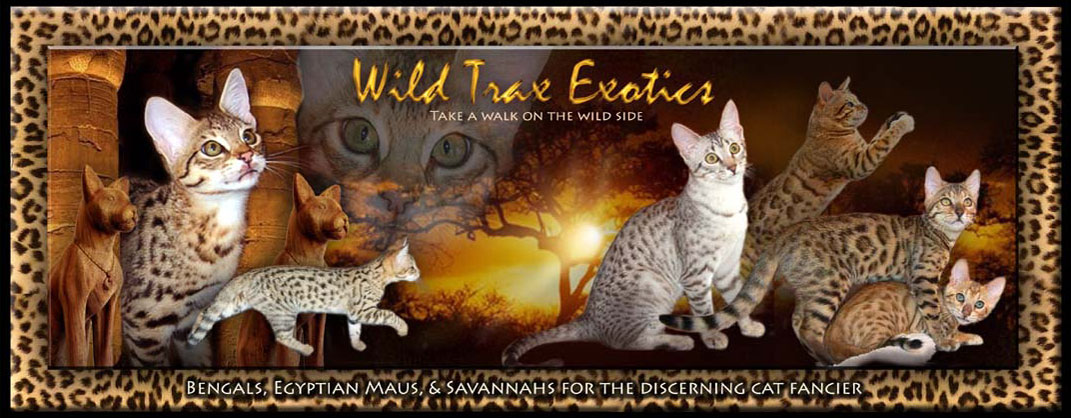
Wild Trax Exotics is a TICA registered
cattery and we are located in Central Arkansas. We specialize
in high quality Egyptian Maus and SBT Bengals. All with
excellent bloodlines, wild looks, and gentle loving
temperaments, raised in a small in-home cattery with
lots of socialization with people and other animals.
Most of our kittens are show quality that we offer
as high quality pets, Bengals with very large rosettes
and vivid coloring, Silver Maus with jet black spots
and no taint, and all with super sweet temperaments.
We screen our breeding cats for genetic diseases and
offer a health guarantee on the kittens. Our adoption
contract is posted on the website on the adoption info
page if you would like to look it over. Our breeding
cats have been carefully selected to pass on Gentle
Loving Temperaments, High Contrast Markings, Excellent
Breed Type, Wild Faces, and above all, Good Health.
All kittens are hand raised indoors to ensure they are
well adjusted and socialized to provide you with the
ultimate pet! Because we are a small cattery, we do
not have kittens available at all times, please inquire
about availability and expected litters. We typcially
keep a waiting list year round, so you may have a short
wait before kittens are available to choose from.
Meet the Owner, Operator, and Chief
Pooper-Scooper of Wild Trax Exotics
My name is Tracy Wilson, and I have been surrounded
by all kinds of animals all my life. I am one of those
folks that had a natural affinity with animals from
the day I was born. I have always been involved with
animals in one way or another as a major part of my
life. I have been a state licensed wildlife rehabilitator
for years and also ran a federal and state licensed
wildlife sanctuary for many years that specialized in
the small wild feline species such as servals, ocelots,
caracals, bobcat, lynx, and more. I have over 20 years
experience with all types of big and wild cats from
tigers all the way down to the tiny South American Geoffrey's
Cat. I am also the project director for a nonprofit
rainforest wildlife and habitat conservation project
called Touch The Jungle, located in Ecuador, South America.
We have a wildlife rescue facility there, with an emphasis
on the endangered wild cats species native to the area,
such as margays and ocelots, and we have added an organic farming/agriculture project and high school/trade school to our project work in the Intag area of Northern Ecuador.
I became a Bengal pet owner somewhere in all my animal
rescue work, and fell in love with the breed. Not only
are Bengals stunningly beautiful, but they have many
similar personality qualities as the wild felines, such
as playing in water, playing fetch, their inquisitiveness
and their acrobatics; without the danger of causing
you bodily injury, being much gentler than a true wild
feline, and not requiring any specialized care or housing.
Because I do work with wild felines, I often get requests
from folks wanting to own a wild feline who can not
provide a proper home to a wild feline for whatever
reason and they need an alternative to fill this desire
for a wild feline or exotic looking pet. When I combined
my love of the Bengal with my wild feline rescue work,
I realized that breeding Bengals and providing them
as pets was a great alternative for a lot of people.
There are a lot of people who would like to own a wild
feline but can not legally do so, simply do not want
the responsibility, or cannot provide the extra work
required to care and house for a wild feline. It was
the perfect answer. Bengals are a great alternative
to having a little taste and look of the wild without
all the trouble and responsibility of a true pure wild
cat!
I started breeding bengals in 2003, being mentored
under a friend who had been breeding bengals for many
years. It is important for new breeders to be mentored
by an experienced breeder. This helped me understand
how the breed genetics work, how to select which cats
to breed for the best traits and improve the breed,
meet other breeders, and learn how to screen potential
buyers for proper homes. Once I had a become knowledgeable
about the breed, I carefully began selecting high quality
bengals from exceptional bloodlines for breeding in
order to provide amazing kittens for you with great
personalities and beautiful wild looks.
Egyptian Maus
I have always admired this breed for as long as I can
remember. But pure high quality Maus are pretty rare
and it is hard to come across available kittens. Most
Mau breeders have very long waiting lists. I had been
on one of those lists waiting for over year and still
had no kitten! By chance, a friend of mine, a fellow
breeder, happened to have one little male become available
in 2005, and she offered him to me. I jumped at the
opportunity because I had wanted to work with them for
so long. I absolutely fell in love with my first Mau,
and it wasn't long before I was searching for a compatible
mate for him. I found him a couple of nice girls and
they have all turned out to be very loving and affectionate
cats. Maus are the sweetest cats you will ever meet
and a joy to raise. Maus also have the high intelligence
of the wild cats and high energy to match, while being
super affectionate as well.
Other Animal Related Projects I Am
Involved In...
 I
also run a website that sells specialized products for
wild felines. Check it out, I have a great feline vitamin
for raw meat diets, that is really good for Bengals
and other hybrids, wild cat sepcies, as well as any
breed of domestic cat:
Wild Trax Supply. I use the Wild Trax Feline
Supplement on all my wild felines and the Bengals &
Maus, and have seen great results from using it. I
also run a website that sells specialized products for
wild felines. Check it out, I have a great feline vitamin
for raw meat diets, that is really good for Bengals
and other hybrids, wild cat sepcies, as well as any
breed of domestic cat:
Wild Trax Supply. I use the Wild Trax Feline
Supplement on all my wild felines and the Bengals &
Maus, and have seen great results from using it.
 Another
important project that I am involved in....I travel
to Ecuador, South America, several times a year to work
at a rainforest reserve. The name of the nonprofit project
is Touch The Jungle
and the reserve is Playa de Oro Reserva de Tigrillos.
I have been volunteering at this reserve since 2002,
and in 2006 I became the reserve's International Project
Director. The main purpose of the reserve is habitat
preservation and to protect the native wildcat species
of the area which are ocelot, margay, oncilla, tigrina,
jaguarundi, jaguar, and puma.We also have a wildlife
rescue center located in the nearby Intag Cloud Forest.
I oversee the wildlife rehabilitation program here,
and it is very rewarding work because in most cases
the animals we help here are endangered species. We
also built a high school/trade school in
2014 for the locals of teh Intag Valley who are dedicated to projecting
the forest and wildlife but need education to help them
do so. w ehave expanded into organic farming/agriculture project here as well. If you would like to help out, please visit the
Touch
The Jungle's website for info on how you can
donate. You can even travel to the project yourself
to help support our efforts! Another
important project that I am involved in....I travel
to Ecuador, South America, several times a year to work
at a rainforest reserve. The name of the nonprofit project
is Touch The Jungle
and the reserve is Playa de Oro Reserva de Tigrillos.
I have been volunteering at this reserve since 2002,
and in 2006 I became the reserve's International Project
Director. The main purpose of the reserve is habitat
preservation and to protect the native wildcat species
of the area which are ocelot, margay, oncilla, tigrina,
jaguarundi, jaguar, and puma.We also have a wildlife
rescue center located in the nearby Intag Cloud Forest.
I oversee the wildlife rehabilitation program here,
and it is very rewarding work because in most cases
the animals we help here are endangered species. We
also built a high school/trade school in
2014 for the locals of teh Intag Valley who are dedicated to projecting
the forest and wildlife but need education to help them
do so. w ehave expanded into organic farming/agriculture project here as well. If you would like to help out, please visit the
Touch
The Jungle's website for info on how you can
donate. You can even travel to the project yourself
to help support our efforts!
Thank you for getting to know me and my animals, and
I hope I can provide you with a beautiful kitten to
become your newest (and most spoiled) family member!
|